
Cursos de Ayurveda: Introduction to Ayurvedic Massage (Abhyanga) Workshop Offered by Escuela de Ayurveda de California
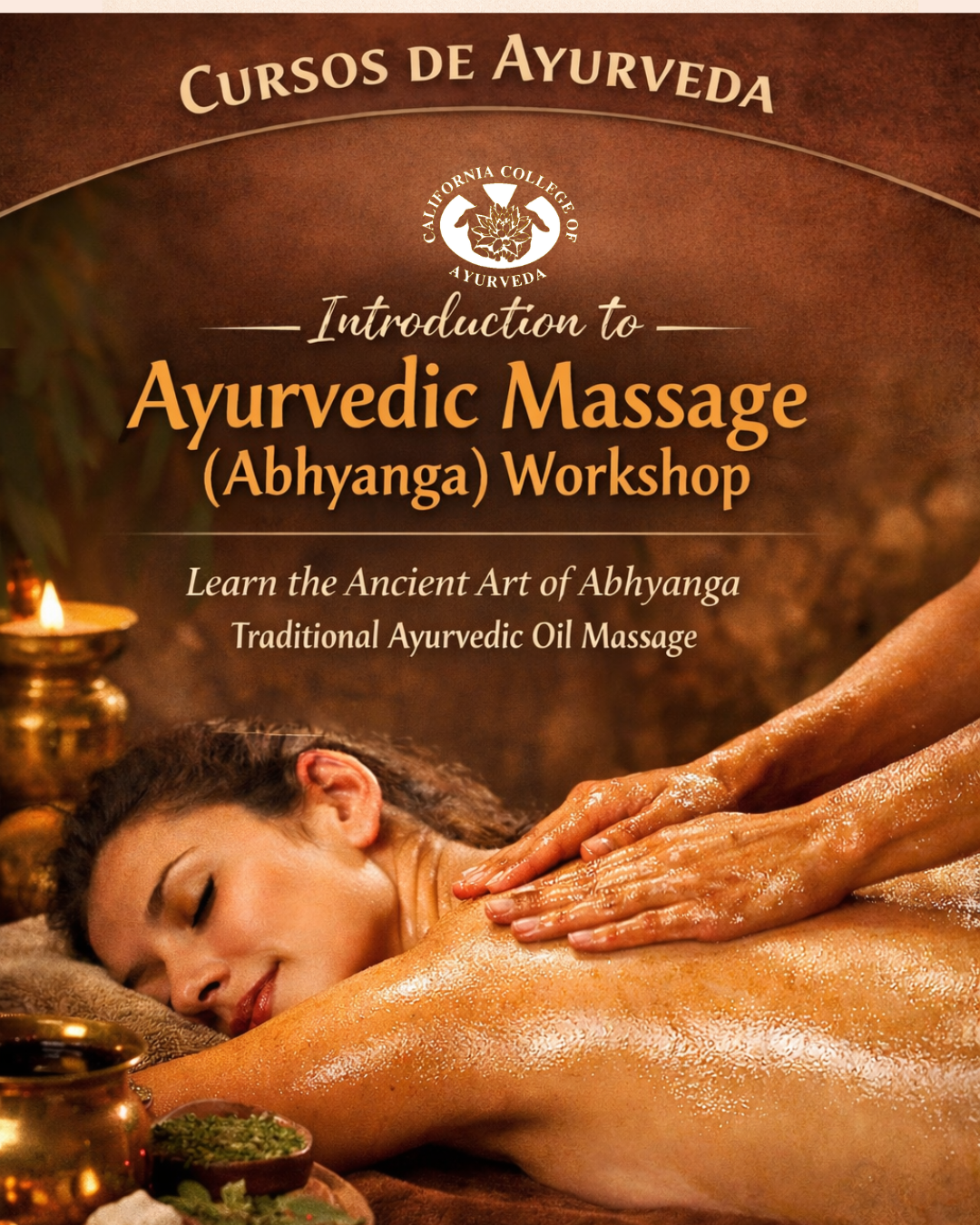
Curso Masaje Ayurveda
Join the international workshop "Introduction to Ayurvedic Massage (Abhyanga)". Learn traditional massage for deep relaxation, and holistic self-care.
Ayurveda is a universal science of life, but education must be delivered in a way that resonates with the community. ”
LOS ANGELES, CA, UNITED STATES, February 28, 2026 /EINPresswire.com/ -- The Escuela de Ayurveda de California has announced the opening of enrollment for its upcoming Introduction to Ayurvedic Massage (Abhyanga) Workshop, a comprehensive one-month online training designed to introduce participants to the foundational principles and practical techniques of one of Ayurveda’s most revered therapeutic practices. Taught entirely in Spanish and accessible internationally, the program begins March 14 and will be led by Santiago Suarez, Director for Latin America.— Santiago Suarez Rubio CAS
As global interest in holistic health, integrative medicine, and traditional self-care practices continues to accelerate, this workshop offers a structured and authentic entry point into the science of Ayurvedic bodywork. The course is open to beginners, wellness professionals, therapists, and anyone interested in natural health approaches. While the program itself is not a certification course, it serves as a required prerequisite for students intending to pursue professional training in Ayurvedic massage.
Reintroducing a Classical Practice for Contemporary Life
Abhyanga, the traditional Ayurvedic oil massage described in classical Sanskrit texts, has been practiced for thousands of years as a daily health ritual and therapeutic intervention. Unlike many modern massage modalities that focus primarily on muscular tension, Abhyanga is designed to influence the nervous system, lymphatic circulation, skin health, and energetic balance simultaneously.
The workshop emphasizes the original intent of the practice: to cultivate deep self-relaxation, support healthy circulation, nourish bodily tissues, and promote systemic balance. Participants will learn how self oil application and specific directional strokes can calm the mind, ground the body, and restore equilibrium disrupted by stress, irregular routines, or environmental factors.
“Abhyanga is not merely a technique; it is a dialogue with the body,” said Mr. Suarez. “In a world where overstimulation and chronic stress are common, this practice provides a methodical way to reestablish physiological and psychological stability through conscious touch.”
Structured Learning in an Accessible Format
Delivered through a live online classroom with access to session recordings, the workshop is designed to accommodate participants across time zones while maintaining the interactive quality of real-time instruction. Over the course of one month, students will engage in theoretical discussions, and self-practice recommendations that allow them to progressively integrate the techniques into their personal routines.
The program does not include materials, enabling participants to source oils and supplies according to regional availability while receiving guidance on appropriate selections.
Key learning outcomes include:
Fundamental principles of Ayurvedic massage (Abhyanga)
Basic techniques for therapeutic oil application
Therapeutic qualities and selection of Ayurvedic oils
Understanding benefits according to individual constitution (dosha) and contraindications
Strategies for integrating Abhyanga into sustainable self-care practices
By the end of the workshop, participants will possess a working understanding of how to safely perform self-massage and adapt the practice according to constitutional needs, seasonal influences, and lifestyle factors.
Personalized Wellness Through Constitutional Awareness
A distinguishing feature of Ayurveda is its emphasis on individual constitution, or dosha, as the basis for personalized health strategies. The workshop introduces participants to how Abhyanga can be adapted for Vata, Pitta, and Kapha constitutions, including variations in oil selection, pressure, rhythm, and frequency.
Understanding contraindications is also a core component of the training, ensuring that participants learn when to modify or avoid the practice in the presence of specific conditions such as acute illness, inflammation, or digestive disturbances.
This individualized approach reflects Ayurveda’s broader philosophy: health is not achieved through uniform prescriptions but through alignment with one’s unique physiological and psychological profile.
A Gateway to Professional Training (Instituto, Escuela y Universidad de Ayurveda)
Although the Introduction to Ayurvedic Massage workshop is not a certification program, it plays a critical role within the school’s educational pathway. Completion of the course is required before enrolling in the professional Ayurvedic massage training, ensuring that all students share a foundational understanding of principles, terminology, and safety considerations.
By structuring the curriculum in this way, the institution aims to preserve the integrity of traditional teachings while maintaining high educational standards for future practitioners.
Expanding Access to Authentic Ayurveda in Spanish
The workshop is part of a broader initiative to expand access to classical Ayurvedic education for Spanish-speaking communities worldwide. Demand for professional-level training in integrative wellness has grown significantly across Latin America and among Spanish-speaking populations in the United States and Europe.
Offering the program entirely in Spanish removes a major barrier to entry and allows participants to engage with complex concepts in their native language, improving comprehension and practical application.
Mr. Suarez emphasized the importance of cultural and linguistic accessibility: “Ayurveda is a universal science of life, but education must be delivered in a way that resonates with the community. Teaching in Spanish allows us to reach practitioners and individuals who might otherwise be excluded from high-quality training.”
Enrollment Details and Tuition
Enrollment for the March program is limited to maintain an optimal learning environment and ensure personalized attention during live sessions.
Program details:
Start Date: March 14
Duration: 1 month
Format: Online — live classes with recording access
Instructor: Santiago Suarez, Director for Latin America
Materials: Not included
Early registration is strongly encouraged due to limited capacity.
Additional Training Opportunity in Ayurvedic Nutrition
Participants interested in a broader exploration of Ayurvedic lifestyle practices may also enroll in the Introduction to the Principles of Ayurvedic Nutrition course beginning June 28. Students who register for both the massage workshop and the nutrition program will receive an additional discount, supporting a comprehensive approach to self-care that integrates bodywork and dietary wisdom.
Together, these programs reflect Ayurveda’s holistic framework, where daily routines, nutrition, and therapeutic practices function synergistically to maintain health and prevent disease.
Meeting the Growing Demand for Preventive Self-Care
Healthcare systems worldwide are increasingly recognizing the importance of preventive approaches and patient empowerment. Practices such as Abhyanga align with this paradigm by providing individuals with tools to manage stress, improve sleep quality, support immune function, and cultivate body awareness without reliance on external interventions.
Research into touch therapy and oil massage has suggested potential benefits for autonomic regulation, mood stabilization, and skin barrier function — outcomes consistent with classical Ayurvedic claims.
By teaching safe, structured self-application, the workshop aims to bridge traditional knowledge and contemporary wellness needs.
Who Should Attend
The Introduction to Ayurvedic Massage workshop is designed for a diverse audience, including:
Individuals seeking natural self-care practices
Massage therapists and bodyworkers expanding their skill set
Yoga teachers and wellness coaches
Students considering professional Ayurvedic training
Healthcare practitioners interested in integrative approaches
Students throughout Latin America, Spain and Ayurveda Mexico
No prior experience is required.
About the Instructor
Santiago Suarez, CAS serves as Director for Latin America and has extensive experience teaching Ayurvedic principles, bodywork techniques, and lifestyle practices to Spanish-speaking audiences. His approach integrates classical teachings with practical instruction tailored for modern students, emphasizing safety, clarity, and applicability.
Registration and Further Information
Due to limited enrollment capacity, prospective participants are encouraged to secure their place promptly. Additional details regarding schedules, registration procedures, and future professional training pathways are available through the school’s admissions office.
About the Escuela de Ayurveda de California (Instituto Ayurveda in Spanish)
The Escuela de Ayurveda de California is a leading institution dedicated to the preservation and dissemination of traditional Ayurvedic knowledge through professional training programs, workshops, and public education initiatives. With an international student body and multilingual offerings, the school seeks to make authentic Ayurvedic education accessible while maintaining rigorous academic and ethical standards.
Santiago Suarez
Escuela de Ayurveda de California
+1 530-616-8332
email us here
Visit us on social media:
LinkedIn
Instagram
Facebook
YouTube
Introducción a Ayurveda
Legal Disclaimer:
EIN Presswire provides this news content "as is" without warranty of any kind. We do not accept any responsibility or liability for the accuracy, content, images, videos, licenses, completeness, legality, or reliability of the information contained in this article. If you have any complaints or copyright issues related to this article, kindly contact the author above.
