

Tiny plastics, big damage: How road pollutants threaten developing eyes
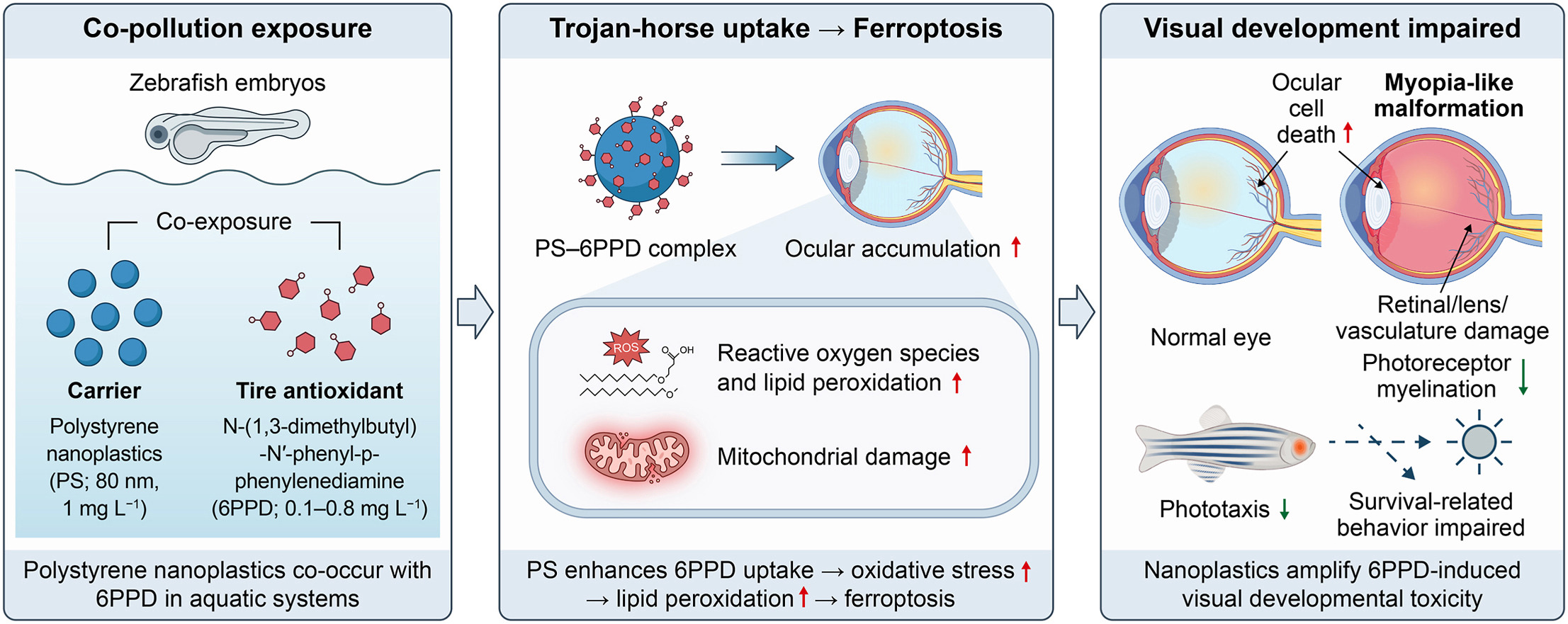
Nanoplastics Act as “Trojan Horses” to Amplify 6PPD-Induced Visual Toxicity.
GA, UNITED STATES, January 29, 2026 /EINPresswire.com/ -- Emerging evidence suggests that environmental pollutants rarely act alone, yet most toxicological studies still assess them in isolation. This research reveals that nanoplastics can dramatically intensify the eye toxicity of a common tire-derived chemical, transforming moderate exposure into severe visual damage. Using a vertebrate model, the study demonstrates that nanoplastics act as carriers that increase chemical uptake in eye tissues, leading to abnormal eye structure, impaired vision-related behavior, and widespread cellular damage. These findings highlight a previously underappreciated risk of combined pollution, showing that interactions between plastics and chemical additives can produce synergistic effects far more harmful than either contaminant alone, with potential consequences for survival and ecosystem health.
Micro- and nanoplastics are now pervasive in aquatic environments, largely originating from plastic degradation and tire wear particles released from roads. Tire additives, designed to prevent rubber degradation, are routinely washed into rivers and coastal waters, where they coexist with plastic debris. Previous studies have shown that nanoplastics can adsorb hydrophobic chemicals, potentially altering their biological effects. Meanwhile, tire-derived compounds have been linked to developmental and neurological toxicity in aquatic organisms. However, little is known about how these pollutants interact during early development, particularly in sensitive organs such as the eye. Based on these challenges, it is necessary to conduct in-depth research on how combined plastic–chemical exposures affect visual development and function.
Researchers from Wenzhou Medical University and the Chinese Academy of Sciences reported (DOI: 10.1016/j.ese.2026.100657) on January 8, 2026, in Environmental Science and Ecotechnology, that nanoplastics significantly worsen eye damage caused by the tire antioxidant 6PPD. Using zebrafish embryos, a well-established vertebrate model for vision research, the team investigated how polystyrene nanoplastics interact with 6PPD during early development. Their results show that combined exposure leads to more severe eye malformations, impaired visual behavior, and molecular disruption than exposure to the chemical alone.
The researchers exposed zebrafish embryos to environmentally relevant concentration of polystyrene nanoplastics, sublethal concentrations of 6PPD, or a combination of both. While 6PPD alone caused measurable eye abnormalities, co-exposure with nanoplastics dramatically amplified these effects. Embryos showed myopia-like eye malformations, disrupted retinal structure, and increased cell death in ocular tissues. Behavioral tests further revealed impaired phototaxis, indicating functional vision loss.
Advanced imaging demonstrated that nanoplastics accumulated preferentially in the eye and significantly increased the internal concentration of 6PPD. This “Trojan horse” effect allowed the chemical to penetrate deeper into sensitive visual tissues. Histological analysis confirmed damage to the retina, lens, and ocular blood vessels, while dual-omics profiling uncovered widespread disruption of genes and proteins involved in phototransduction, eye morphogenesis, and oxidative stress regulation.
Notably, the study identified ferroptosis—an iron-dependent form of cell death driven by lipid peroxidation—as a central mechanism underlying the amplified toxicity. Co-exposure triggered excessive reactive oxygen species, mitochondrial damage, and collapse of antioxidant defenses, leading to irreversible visual impairment. Together, these findings demonstrate that nanoplastics fundamentally change how tire-derived chemicals interact with developing biological systems.
“Our results show that nanoplastics are not just passive debris,” the researchers noted. “They actively transport toxic chemicals into developing tissues, greatly increasing biological damage.” The team emphasized that the eye is especially vulnerable due to its direct exposure and complex neural structure. By uncovering ferroptosis as a key mechanism, the study provides new insight into how combined pollutants overwhelm cellular defenses. According to the authors, assessing pollutants one by one may substantially underestimate real-world risks, particularly in environments affected by road runoff and plastic pollution.
These findings have important implications for environmental risk assessment and aquatic ecosystem protection. Visual impairment can directly reduce survival by compromising feeding, predator avoidance, and navigation. The study suggests that current regulatory frameworks, which often evaluate chemicals and plastics separately, may fail to capture the true hazards of mixed pollution. By highlighting nanoplastics as active amplifiers of chemical toxicity, the research calls for integrated approaches to pollution management. Future studies may explore whether similar interactions threaten other organs or affect human health. Ultimately, understanding how pollutants interact is essential for developing more accurate environmental safety standards in an increasingly plastic-contaminated world.
DOI
10.1016/j.ese.2026.100657
Original Source URL
https://doi.org/10.1016/j.ese.2026.100657
Funding information
This work was supported in part by funding from the Natural Science Foundation of Zhejiang Province (No. ZCLY24B0702), Wenzhou Science and Technology project (No. S2023007), Wenzhou Municipal Key Laboratory of Neurodevelopmental Pathology and Physiology (No. 2023HZSY0003), the Project of South Zhejiang Institute of Radiation Medicine and Nuclear Technology (No. ZFY-2022-K-004) and National Innovation and Entrepreneurship Training Program for College Students (No. S202510343117X).
Lucy Wang
BioDesign Research
email us here
Legal Disclaimer:
EIN Presswire provides this news content "as is" without warranty of any kind. We do not accept any responsibility or liability for the accuracy, content, images, videos, licenses, completeness, legality, or reliability of the information contained in this article. If you have any complaints or copyright issues related to this article, kindly contact the author above.
